

Sergey Kofanov
48 years, Australia
9 years ago
THE SEVEN SUMMITS: COST, DIFFICULTY & CLIMBING ORDER
Updated: October 2026.
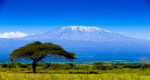
The Seven Summits are the highest mountains on each of the seven continents and one of the best-known long-term challenges in mountaineering.
From 2005 to 2008, while working as a mountain guide, I focused heavily on the Seven Summits program and completed it twice. I originally wrote this article to explain how much time, money and experience an ordinary person might need to complete the challenge.
A lot has changed since then. Expedition prices have increased dramatically, commercial climbing has evolved, and my own view of how a climber should approach the Seven Summits has also changed.
So this is the updated 2026–27 version: the complete Seven Summits list, the difference between the Bass and Messner lists, the easiest-to-hardest question, a sensible climbing order, current expedition costs and the experience you should build before attempting the most serious peaks.
Short answer: for most recreational climbers, the Seven Summits should be treated as a 3–5 year or longer progression, not as seven unrelated trips. Start on the easier peaks, deliberately build altitude and technical experience, and leave Everest until the end.
What are the Seven Summits?
Six mountains are common to both established versions of the Seven Summits: Everest in Asia, Aconcagua in South America, Denali in North America, Kilimanjaro in Africa, Elbrus in Europe and Vinson in Antarctica.
The difference is the seventh summit. The Bass list uses Mount Kosciuszko in Australia, while the Messner list uses Carstensz Pyramid, also known as Puncak Jaya, in Western New Guinea.
Already started your Seven Summits?
We are building Mountain Passport — one place to save your summits, climbing dates and routes and build your personal climbing history.
Track my Seven Summits Bass vs Messner: why are there two Seven Summits lists?
The difference comes down to how the Australian/Oceanian continent is defined.
Dick Bass used Mount Kosciuszko, the highest mountain on mainland Australia. Reinhold Messner used Carstensz Pyramid, the highest summit on the wider Australasian continental landmass.
From a mountaineering point of view, the difference is enormous. Kosciuszko is essentially a hike. Carstensz is a remote expedition with exposed technical rock climbing, rope work and complicated logistics.
Both versions exist historically, but many climbers today who want a more complete mountaineering challenge choose the Messner list and climb Carstensz.

Photo: Nicolas Perez for Unsplash
Seven Summits easiest to hardest
One of the most common questions about the program is: what are the Seven Summits in order of difficulty?
The problem is that there is no universal ranking.
Technical difficulty, altitude, weather, cold, expedition duration, physical load and remoteness are very different kinds of difficulty. A climber who is comfortable on rock may find Carstensz relatively straightforward but struggle at extreme altitude. Another climber may have excellent endurance at altitude but little confidence on exposed rock.
For a recreational climber progressively building experience, I would roughly think about the mountains in the following order:
- Mount Kosciuszko – if you follow the Bass list; essentially a mountain hike.
- Kilimanjaro – non-technical, but altitude makes it a serious first test.
- Mount Elbrus – introduces crampons, snow and basic glacier skills.
- Aconcagua – technically moderate on the Normal Route, but significantly higher and longer.
- Mount Vinson – technically moderate, but Antarctic cold, remoteness and logistics increase the challenge.
- Carstensz Pyramid – lower altitude but genuine technical rock climbing and exposure.
- Denali – heavy loads, glacier travel, severe weather and a high level of expedition self-sufficiency.
- Mount Everest – extreme altitude, long exposure and the greatest overall consequences of illness or mistakes.
Do not treat this order as a mathematical ranking. Vinson, Carstensz and Denali in particular may change places depending on your climbing background.

Photo: Kalle Kortelainen for Unsplash
What is the best order to climb the Seven Summits?
My main recommendation has not changed since I first wrote this article: do not start with Everest.
The Seven Summits make much more sense when each mountain prepares you for the next one. Your objective should not simply be to collect seven summits. It should be to become a substantially better mountaineer during the process.
If I were planning the program today for a physically fit person with little previous mountaineering experience, a sensible progression would look roughly like this:
Kilimanjaro → Elbrus → Aconcagua → Carstensz and/or Vinson → Denali → Everest.
Start with Kilimanjaro
From my own perspective, Kilimanjaro remains one of the best first mountains in the Seven Summits program.
You do not normally need technical climbing skills on the standard trekking routes. More importantly, the mountain gives you an early understanding of altitude: how your body responds to reduced oxygen, how important pacing and acclimatization are, and how different summit day feels above 5,000 metres.
Kilimanjaro is often described as an easy mountain. Technically that may be true, but altitude makes any mountain serious.

Continue with Elbrus
Elbrus is lower than Kilimanjaro and Aconcagua, but it introduces a useful new set of skills: crampon use, snow travel, an ice axe, glacier terrain and a long summit day.
That makes it a logical bridge between high-altitude trekking and more serious expedition mountaineering.
Access, operator availability and international travel conditions can change, so check current logistics before planning an Elbrus expedition.
Then use Aconcagua to learn expedition life
Aconcagua changes the scale of the project. The Normal Route is not highly technical, but the mountain rises to almost 7,000 metres and a normal expedition lasts roughly three weeks.
You learn to acclimatize over a much longer period, recover between carries, live at altitude and remain psychologically focused through a full expedition rather than a one-week trip.
Where does Kosciuszko fit?
If you follow the Bass list, Mount Kosciuszko can be climbed almost anywhere in the sequence. It does not require the progression of technical skills needed for the other major peaks.
Many climbers therefore leave it until later simply because it is easy to organize and can become an enjoyable trip rather than an expedition objective.

Carstensz and Vinson build different skills
Carstensz Pyramid and Mount Vinson are difficult for completely different reasons.
Carstensz involves sustained exposure and technical rock climbing. Climbers should be comfortable with rock-climbing fundamentals, rope handling and exposed terrain before joining this kind of expedition.
Vinson is technically more moderate, but Antarctica adds extreme cold, remoteness and complex logistics. Climbers should already be comfortable with basic snow and glacier travel techniques.
Leave Denali for the second half
I would not recommend Denali as an early Seven Summits mountain.
On the West Buttress, climbers need proper expedition camping skills, cramponing, self-arrest, crevasse rescue and roped glacier travel. You also move large loads using both a backpack and sled.
A guided Denali expedition still expects climbers to arrive with real mountaineering skills rather than learn everything during the expedition.

Photo: Anna Tremewan for Unsplash
Everest should come last
This is probably the biggest change from the original version of this article.
Everest should not be your first mountain.
Modern commercial expeditions provide extraordinary infrastructure, experienced guides, Sherpa support, fixed ropes and supplemental oxygen. But none of those things replaces the climber's own experience.
Reputable guided Everest expeditions expect climbers to arrive with mountaineering training, experience on glaciated mountains and previous high-altitude experience, commonly above 6,000 metres.
Your earlier Seven Summits should therefore be preparation for Everest rather than simply boxes that you tick before flying to Nepal.
How much does it cost to climb the Seven Summits in 2026–27?
This is where the original article had become most outdated.
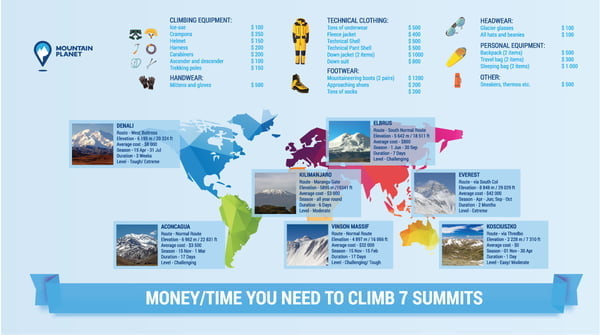
Expedition prices have risen substantially. The figures below are representative published prices for major guided expeditions, not universal market averages. Operators may offer very different guide ratios, logistics, accommodation, equipment and inclusions.
Duration: about 7–9 climbing days
Guided price: approx. $5,300–$7,500 climb-only
Main challenge: altitude and endurance
Duration: about 8–12 days
Guided price: varies widely by operator, inclusions and current logistics
Main challenge: snow, crampons, altitude and weather
Duration: about 19–21 days
Guided price: around $7,800
Main challenge: high altitude and expedition endurance
Duration: about 21 days
Guided price: around $12,250
Main challenge: heavy loads, glaciers and severe weather
Duration: about 11 days
Guided price: around $26,000
Main challenge: technical rock, exposure and remote logistics
Duration: about 16 days
Guided price: around $55,500
Main challenge: Antarctic cold and remoteness
Duration: about 40–55 days
Guided price: around $80,000 with a major international operator
Main challenge: extreme altitude and prolonged exposure
Duration: 1 day
Cost: no major expedition fee for a normal independent hike
Main challenge: hiking fitness
Using representative current guided prices, a Messner-list Seven Summits program can require roughly $190,000 or more in expedition fees alone.
And that is not the full cost.
You also need to budget for international flights, hotels, equipment, insurance, visas, tips, training climbs, airport transfers, optional personal support and the possibility of returning after an unsuccessful expedition.
A realistic total budget can therefore move comfortably beyond $200,000.
The Bass version can be considerably cheaper because Kosciuszko replaces Carstensz, but Everest and Vinson still dominate the overall cost.

How much should you spend on equipment?
The original version of this article tried to calculate one complete Seven Summits equipment package. Today I would approach it differently.
Do not buy everything before your first mountain.
The equipment required for Kilimanjaro is very different from what you eventually need for Denali, Vinson or Everest. Build your system gradually as your experience develops.
- mountaineering and high-altitude boots;
- crampons, harness, ice axe, ascender and other technical equipment;
- technical shell layers;
- high-quality insulation and expedition down clothing;
- extreme-cold gloves and mittens;
- sleeping systems;
- backpacks and expedition duffels;
- glacier glasses and goggles;
- headlamps, trekking poles and personal safety equipment.
Some expensive items can be rented, especially early in the program. The objective is not to own the most expensive equipment. It is to understand exactly why you are carrying every item.
For an example of how a mountain-specific list is structured, see the Mount Elbrus gear list.
How long does it take to complete the Seven Summits?
For someone with a normal career and family life, I still consider three to five years a sensible planning horizon. Taking longer is completely normal.
- you need time to build skills rather than simply collect peaks;
- major expeditions can require several weeks away from home;
- climbing seasons overlap;
- weather can end an expedition regardless of your preparation;
- not every mountain will necessarily be climbed on the first attempt;
- your body needs recovery after major expeditions;
- the financial commitment is substantial.
Speed records belong to an entirely different version of the Seven Summits challenge. They should not be the benchmark for an ordinary climber.
Can a beginner climb the Seven Summits?
You can start the Seven Summits as a beginner. You should not finish them as one.
Kilimanjaro can be an excellent first high-altitude objective for a fit beginner with professional support.
But the later mountains require progressively more knowledge. By the time you reach Denali, Vinson, Carstensz and especially Everest, you should already have substantial expedition experience.
A professional guide can provide expertise and support, but a guide cannot replace your own fitness, acclimatization, technical ability and judgment.
Do you need a guide for the Seven Summits?
There is no single answer for every mountain or every climber.
Experienced mountaineers may climb some peaks independently where regulations and logistics allow. For a recreational climber, however, professional guiding can simplify permits, camps, acclimatization planning, route finding, group equipment and emergency procedures.
On remote objectives such as Vinson, Carstensz and Everest, professional logistics are usually a major part of the expedition itself.
Seven Summits FAQ
Which is the easiest of the Seven Summits?
If you use the Bass list, Mount Kosciuszko is clearly the easiest. On the Messner list, Kilimanjaro is normally the most accessible starting point because its standard routes do not require technical mountaineering skills.
That does not make altitude or summit day easy.
Which is the hardest of the Seven Summits?
For most recreational climbers, Everest is the greatest overall challenge because of its extreme altitude, expedition duration and consequences of illness or mistakes.
Denali can be more demanding in other ways because climbers carry heavy loads, work in severe weather and need much greater expedition self-sufficiency.
Why are there eight mountain names in a Seven Summits article?
Because there are two established lists. Bass uses Kosciuszko; Messner uses Carstensz Pyramid. The remaining six mountains are the same.
Can Everest be your first mountain?
I strongly advise against it.
Commercial Everest expeditions now have exceptional support infrastructure, but reputable operators still expect previous mountaineering training, glaciated climbing experience and experience at high altitude.
How much do the Seven Summits cost?
Using representative 2026–27 guided expedition prices, the expedition fees for a Messner-list program can reach roughly $190,000 or more. Once flights, equipment, insurance, training, tips and contingencies are added, the overall cost can exceed $200,000 by a substantial margin.
How many years do you need for the Seven Summits?
There is no required timeline. For a non-professional climber, three to five years is a reasonable target, but there is no benefit in rushing simply to complete the list.
Build your Mountain Passport
Your climbing history is bigger than a list of check marks.
Save the mountains you have climbed, dates and routes, track your Seven Summits progress and create a climbing profile you can share.
Create my Mountain Passport
Early access — Mountain Passport is currently in development.
My final advice
When I first became involved with the Seven Summits, it was easy to see the challenge as a checklist: seven continents, seven mountains, seven summits.
Today I see it differently.
The real value is the progression.
Kilimanjaro teaches you about altitude. Elbrus introduces basic snow and glacier skills. Aconcagua teaches expedition patience. Carstensz adds technical rock. Vinson introduces Antarctic cold and true remoteness. Denali forces you to become more self-reliant. Everest should then become the culmination of the experience rather than a shortcut to it.
Do not rush the Seven Summits. Use the Seven Summits to become a better mountaineer.

Your mountain journey also does not have to end with the Seven Summits. There are the Volcanic Seven Summits, the Second Seven Summits and hundreds of other mountains that may ultimately mean much more to you than completing any particular list.
You can explore some of them in Top 10 Most Guided Mountains in the World and Why, Top 5 Most Expensive Summit Trips in the World and Classification of Guided Climbs.
Price note: expedition prices above are indicative published benchmarks checked in October 2026. Prices, inclusions, permits, travel conditions and operator availability can change. Always verify current conditions and pricing before booking.
CLASSIFICATION OF GUIDED CLIMBS
37 Like
•
Sergey Kofanov
The Magic Pillar. A pure alpine-style first ascent of the west ridge of Jannu in Nepal (article from American Alpine Journal)
26 Like
•
Sergey Kofanov
ALL YOU NEED TO KNOW BEFORE CLIMBING MOUNT KILIMANJARO SAFELY
17 Like
•
Sergey Kofanov
7 RULES TO PREVENT DEADLY RISKS WHILE CLIMBING
8 Like
•
Sergey Kofanov
OPEN by Sergey Kofanov (essay from Alpinist Magazine)
7 Like
•
Sergey Kofanov
WHAT IS MOUNTAIN SICKNESS AND HOW TO FACE IT
4 Like
•
Sergey Kofanov
Man scales Trump Tower
3 Like
•
Sergey Kofanov
FIVE SECRET WAYS TO REDUCE THE COST OF YOUR NEXT MOUNTAIN ADVENTURE
3 Like
•
Sergey Kofanov
ALL YOU NEED TO KNOW TO CLIMB MOUNT DENALI SAFELY
2 Like
•
Sergey Kofanov
A personal appeal from Mountain Planet founder Sergey Kofanov
0 Like
•
Sergey Kofanov